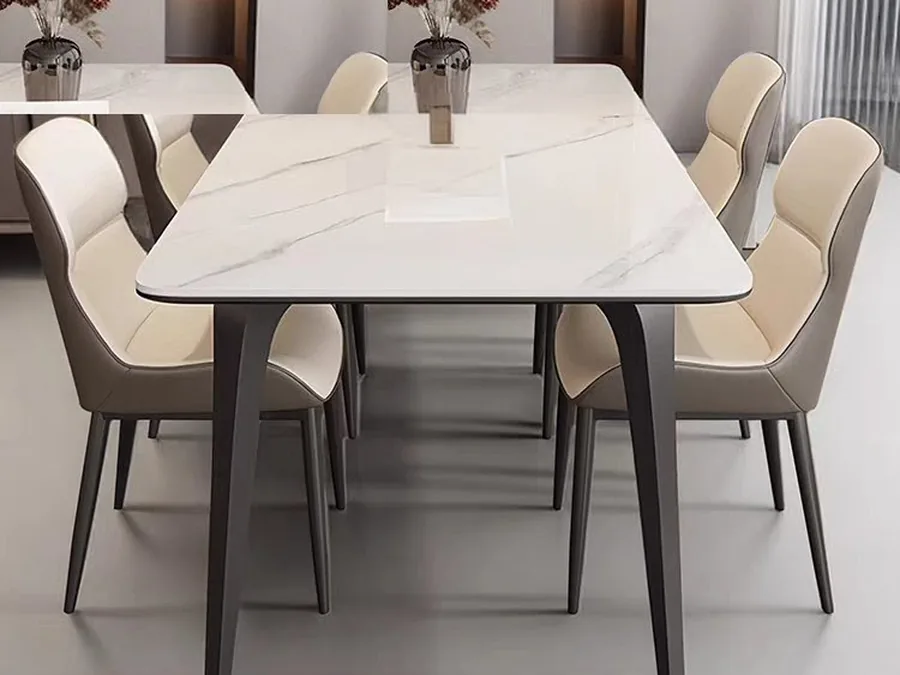
Marble photographs better. Sintered stone survives better. Between those two sentences sits the entire decision, and the reason most restaurant projects get it wrong is that they make it in the showroom instead of in the dish-wash run.
Here is what actually separates the two surfaces once a table is in service.
What each material actually is
A marble top is stone. Cut, polished and sealed, it carries the veins of the block it came from — which is exactly its appeal, and exactly its problem.
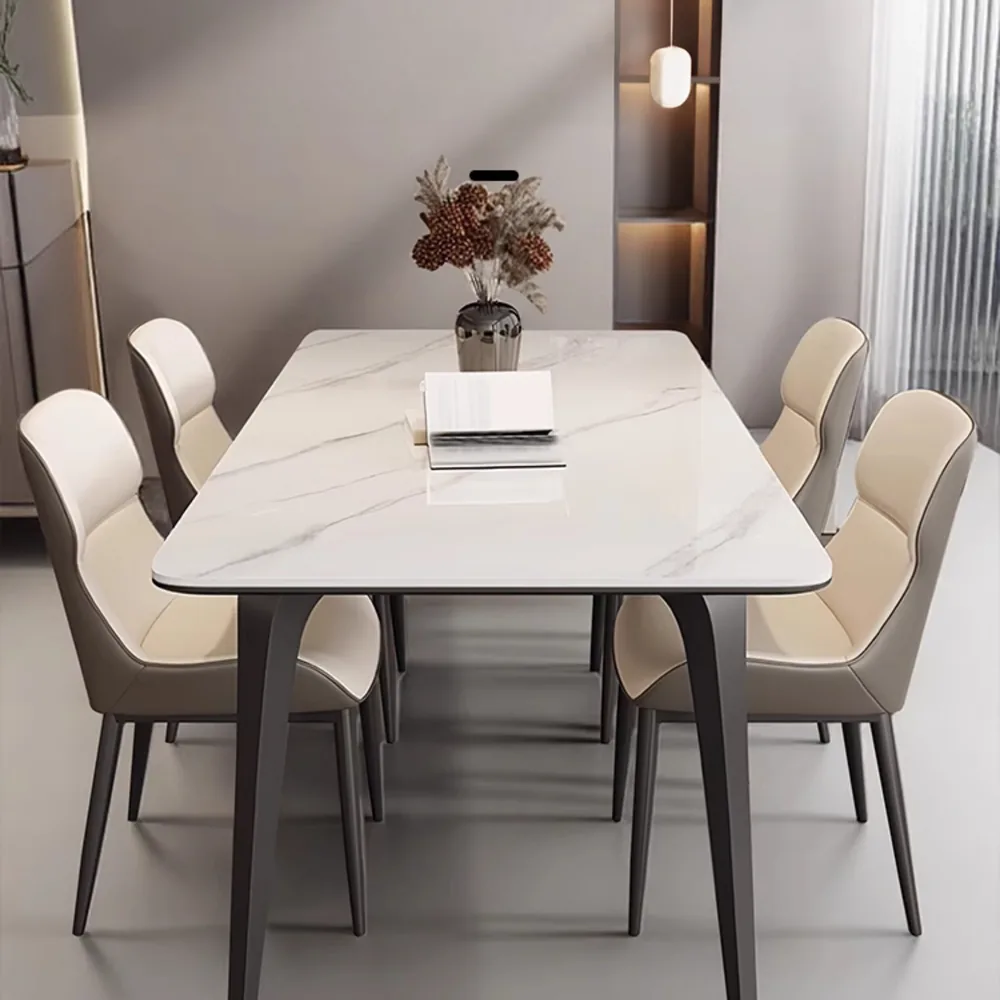
Sintered stone is not stone in that sense. Mineral powders are pressed under high pressure and fired at high temperature until the surface fuses into a slab. There is no sealing required because there is nothing porous left to seal.
Almost every practical difference between the two follows from that one fact. Marble is a natural material with natural variation and an open surface that needs maintenance. Sintered stone is a manufactured slab with a repeatable surface and none.
Cost per square metre, and what sits on top of it
Comparing the unit price of the slab is only the first line of the calculation:
| Cost line | Marble | Sintered stone |
|---|---|---|
| Slab cost per m² | Higher band, and varies by block | Lower band, more consistent |
| Freight | Heavy — weight drives shipping cost | Lighter, so cheaper to move |
| Sealing and upkeep | Periodic, for the life of the table | None after manufacture |
| Replacement | Hard to match a previous batch | Repeatable across orders |
For a single statement table, marble’s premium is easy to justify. For forty tables in a restaurant, the freight line and the upkeep line usually decide it, because both scale with the number of tops rather than with the design fee.
Heat, scratches and staining
This is where service life gets decided.
Heat. A hot pan or a coffee pot left on a table is a normal event, not an accident. A fired surface takes it. A sealed natural stone surface is more exposed, and the damage is not always immediate — heat can mark the sealer first and the stone later.
Scratches. Both resist cutlery reasonably well. Where they differ is in how visible damage is. A scratch on a uniform slab is a scratch. A scratch across marble veining can look like a break in the pattern.
Staining. Wine, oil and citrus are the standard test. Sealed marble gives you a window to wipe before it penetrates; let it sit and the mark may become permanent. A non-porous slab gives you more time, which in a busy room is the whole advantage.
A trivet policy the floor team actually follows is worth more than either material choice. It costs nothing and removes the single most common cause of marks on both surfaces.
Weight and the table base you need
Weight is the hidden cost. A heavy top dictates a heavier base, and the base is where stability, floor loading and staff effort all meet.
Two practical consequences:
- The base has to match the top, not just visually. An under-specified base on a heavy top is how a table starts to feel unstable in month six.
- Someone has to move it. Every table gets moved for cleaning, for events and for floor changes. The weight difference shows up in staff time long before it shows up on an invoice.
Thickness and edge profile belong in the same conversation. A thicker top reads as more substantial and adds weight in a straight line; a thinner one needs a base that supports it properly rather than a heavier base to compensate. The edge profile — straight, bevelled or bullnose — changes how the table feels to a guest resting an arm on it and how the corner behaves when someone walks past. Decide these with the material, not after it, because they change the base specification you order.
If the room is reconfigured often, this alone can outweigh the material comparison.
Replacement and matching over years
Marble is a one-off. Veining means that a top replaced in year three will not match the tops installed in year one — which turns a small repair into a decision about the whole room.
Sintered stone repeats. That matters more than it sounds if you plan phased refurbishment, add covers in a second phase, or simply expect to replace two damaged tops without replacing thirty others.
For a venue refurbishing a dining room this year and a terrace next, that repeatability is the difference between one order and two separate design decisions.
How to decide
| If your priority is… | The better fit is usually… |
|---|---|
| A signature top for a small number of tables | Marble |
| Consistency across a large order | Sintered stone |
| Minimal maintenance over a long service life | Sintered stone |
| A specific natural pattern that defines the room | Marble |
| Matching stock years later | Sintered stone |
Neither surface is wrong. The mistake is choosing on appearance alone and then discovering the maintenance schedule, the freight bill or the matching problem in year two. You can see both options in our dining tables range, check how table size affects seat count in the guide on seats per table length, or send us the room plan and we will come back with top, base and packing options together.
Models from this range
If you are shortlisting for a project, these two pages show how the choices above look in production:
- natural marble dining tables in production — High-End Natural Marble Dining Table in Italian Style
- sintered stone tops with rounded corners — Italian Minimalist Sintered Stone Dining Table with Round Corners